
Boilerplate, not an SDK
Treat Sedim as standardized implementation code you copy into your repo - not a dependency you call at runtime. Learn the patterns from docs, stamp them when needed, customize locally.
Codegen so smort it feels like AI.
Sedim stamps full-stack modules: frontend, backend, schema, and UI, directly into src/sedim/. You own every file. Zero runtime dependency after stamping.
How sedim differs
Runtime SDKs, headless libraries, UI kits, and AI codegen each solve part of the puzzle. Sedim targets the full vertical slice: backend, schema, and UI, as owned, editable code.
| Approach | Examples | Ownership | Customization | Runtime lock-in |
|---|---|---|---|---|
| Runtime SDK | Clerk, Auth0, Supabase Auth | Vendor owns runtime | API surface only | High |
| Headless library | Better Auth, NextAuth | You configure it | Deep, but you wire everything | Medium |
| Copy-paste UI | shadcn/ui blocks | You own components | UI only, no backend | Low |
| AI codegen | Cursor, Claude, Copilot | You own output | Varies every run | Low |
| Sedim stamp model | sedim add auth | You own every file | Full - edit locally forever | None at runtime |
The stamp model
Standardized, secure boilerplate for full-stack features, stamped into your project, not imported at runtime.
Treat Sedim as standardized implementation code you copy into your repo - not a dependency you call at runtime. Learn the patterns from docs, stamp them when needed, customize locally.
Next.js full-stack, or Express/Hono with React/Vue. Drizzle or Prisma. PostgreSQL, MySQL, SQLite. The Detector adapts - no greenfield required.
Files land under src/sedim/. Edit, test, push. No vendor lock-in, no black box. The code you own is the best code - and AI agents skip straight to customization without wasting tokens on grunt work.
Proof, not promises
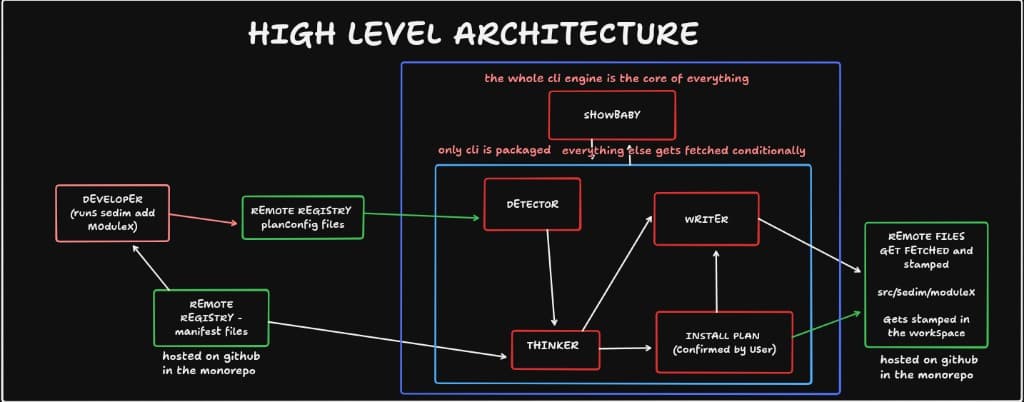
Showbaby previews every file, dependency, and conflict before writing. What lands in your repo is production-grade source, not a runtime SDK.
src/sedim/auth/
├── core/
│   ├── hash-password.ts      # Argon2id (OWASP params)
│   ├── session.ts            # sliding-window sessions
│   ├── pkce.ts               # RFC 7636 S256 only
│   ├── totp.ts               # RFC 6238 + encrypted secrets
│   ├── jwt.ts                # hybrid JWT + refresh tokens
│   └── rbac.ts               # role middleware factories
├── adapters/
│   ├── drizzle.ts            # your ORM adapter
│   └── framework/nextjs.ts   # route handler factory
├── ui/tailwind/              # or headless / themed
│   ├── LoginForm.tsx
│   └── SignupForm.tsx
├── schema.ts                 # users, sessions, oauth…
└── config.ts                 # wire db + providers
src/app/api/auth/[...all]/route.ts
Modules
Each module stamps backend logic, schema, adapters, and UI into your repo. Framework and DB agnostic, three UI tiers per module.
sedim add authIDENTITYSessions, OAuth, TOTP, magic links, JWT, RBAC/ABAC. Frontend + backend + schema, wired to your DB. The first POC - shipping now.
Start with auth →sedim add paymentsCOMMERCEStripe checkout, webhooks, customer portal, recurring billing. Schema and UI included.
On the roadmapsedim add notificationsMESSAGINGEmail, push, and in-app notifications. Multi-channel dispatch with typed templates.
On the roadmapsedim add chatREALTIMEWebSocket messaging, rooms, presence, and UI components. Scale modes from single-node to pub/sub.
On the roadmapsedim add webrtcMEDIAPeer-to-peer video and audio, screen share, TURN fallback. Self-hostable, inspectable code.
On the roadmapsedim add ai-ragAIRAG pipelines, embeddings, vector search, and chat UI. pgvector-first, model-agnostic.
On the roadmapThe pipeline
Scroll to walk through each stage. Every command runs through all four before a single file is written.
Reads your repository - framework, ORM, DB, folder conventions, lockfiles - and stores facts in sedim.config.ts.
Loads the module manifest from the registry, maps it onto your stack, and builds an install plan - files, migrations, env vars.
Walks you through feature selection, shows diffs and conflicts in real time, and confirms the plan before anything writes.
Fetches remote source files and stamps them into src/sedim/. Core logic uses skip strategy - your edits stay safe.
How it works
Detection, feature selection, plan review, stamping, migrations, and running code. Use plan, diff, or --dry-run when you want to preview first.
sedim initInstall the CLI globally. Run init in your project - the Detector identifies your framework, ORM, and database, then writes sedim.config.ts.
sedim add authPick features (OAuth, TOTP, magic links, RBAC…), choose a UI tier, review the install plan, and confirm. Use plan, diff, or --dry-run first if you want.
drizzle-kit pushSet env vars step-by-step during the install flow. Sedim generates migrations for your ORM - run them, and the schema is ready.
npm run devShip with working defaults immediately. Every stamped file lives under src/sedim/ - read it, edit it, test it, push it. No SDK to fight.
Framework & DB agnostic
Framework, DB, and ORM agnostic by design. The Detector adapts the stamp plan to whatever you already run.
| Framework | Scope | Drizzle | Prisma |
|---|---|---|---|
| Next.js (App Router) | Full-stack - frontend + API routes | ✓ | ✓ |
| Express | Backend with React or Vue frontend | ✓ | ✓ |
| Hono | Backend with React or Vue frontend | ✓ | ✓ |
Bring your own design system
Zero CSS - pure logic and markup. Wire into your existing component library or design tokens without fighting pre-baked styles.
Tailwind out of the box
Fully styled with Tailwind classes that work with your existing config. Ship immediately, tweak classes locally.
CSS token themes
Pre-built themes with CSS custom properties - minimal, glass, and more. Swap tokens, keep the logic.
Auth module, shipping now
The first module. Every feature below is stamped as source you own: Argon2id, PKCE S256, encrypted TOTP, non-enumerating magic links, and explicit scalability tradeoffs.
See the CLI
Detects conflicts, empty workspaces, and existing auth libraries before writing. Every command is predictable: init, add, plan, diff, continue, doctor, and --dry-run.
$ npm install -g @sedim/cliInstall the CLI from npm. Zero global state, zero side effects.$ sedim initRun the Detector. Stores your stack into sedim.config.ts.$ sedim add <module>Plan and inject a fully-wired module into your codebase.$ sedim plan <module>Preview the install plan without writing any files.$ sedim diff <module>Show per-file diffs of what a module install would change.$ sedim continue [module]Resume an interrupted module install from where you left off.$ sedim doctorValidate your setup and diagnose common issues before stamping.$ sedim add <module> --dry-runFull interactive flow with zero writes. Review everything first.Who it's for
Hackathon tonight or enterprise audit tomorrow. Sedim meets you in the codebase you already have.
Stamp auth with OAuth and a styled UI in minutes. Skip the repetitive RFC research - customize only what makes your product unique.
Every security decision is readable source in your repo. Argon2id, PKCE, encrypted TOTP secrets - reviewable, not opaque SDK behavior.
Agents customize stamped, production-hardened code instead of writing auth from scratch. No security gaps, no token waste on solved problems.
sedim init reads your stack before planning. Stamps into your folder structure, your ORM, your conventions - not a parallel universe.
Why sedim exists
Generators give you a template. Sedim gives you a teammate who already understood the repo before opening the file.